Breathing Easier This May: What the Latest Asthma Research Means for Malta

World Asthma Month 2026 | Malta Breathe Well Association
May is World Asthma Month, and World Asthma Day this year fell on Tuesday 5 May. It is a moment to refresh what we know about a condition that is closer to home than many people in Malta realise: our islands have long carried one of the highest rates of childhood asthma in the Mediterranean and across the European Union (Montefort et al., 2009). In late spring our combination of Parietaria pollen, low rainfall and dusty winds is a textbook recipe for flare-ups (D’Amato et al., 2007). Below we walk through what the most recent large studies and systematic reviews have added in the past two years ,and what it means in practice.

Asthma in Malta: a local lens on a global problem
Asthma is the most common chronic disease among Maltese children and the leading reason that children miss school (Montefort et al., 2009). Adults are not spared: indoor and outdoor air pollution, the warming climate and a higher prevalence of obesity all push the numbers upward. The Global Initiative for Asthma (GINA) explicitly acknowledged climate change as a driver of asthma exacerbations in its 2025 strategy report, listing damaged healthcare access and worsening air quality as concrete risks (GINA, 2025).
What’s new from large cohort studies
Two recent UK Biobank analyses are worth knowing about. In a cohort of 327,124 adults followed for several years, poor lifestyle was associated with a 3.87-fold higher risk of adult-onset asthma in people who also carried a high genetic-risk score (Wang et al., 2025). “Lifestyle” here is a combination of smoking, physical inactivity, poor diet and high BMI — modifiable factors that matter even when our genes are not in our favour. A separate UK Biobank study of 223,951 adults found that the least-healthy lifestyle category had a 29% higher hazard of incident asthma compared with the healthiest group (Tian et al., 2024).
Sleep is emerging as another piece of the puzzle. In a 2025 prospective cohort of middle-aged and older adults, poor sleep quality (not simply short sleep) was an independent risk factor for developing asthma, suggesting that improving sleep may be a novel prevention target (Liu et al., 2025).
A practical headline for people with mild asthma came from the BATURA trial reported in 2025: replacing a plain “blue inhaler” (albuterol alone) with an albuterol–budesonide combination, taken as needed, reduced severe attacks by nearly 50% — even in patients who were not considered high-risk and whether or not they used a daily preventer (Israel et al., 2025).

Treatment update: GINA 2025 and biologics
The 2025 GINA strategy report continues to recommend an anti-inflammatory reliever (an inhaled corticosteroid combined with formoterol) rather than a short-acting bronchodilator alone, because this approach significantly cuts severe attacks and steroid exposure (GINA, 2025). For severe asthma, six biologic medicines are now available worldwide: omalizumab, mepolizumab, reslizumab, benralizumab, dupilumab and tezepelumab. A 2025 umbrella review of systematic reviews and meta-analyses concluded that all six are effective and have an acceptable safety profile in carefully selected patients with type-2 inflammation (Liang et al., 2025). Real-world data published the same year suggest that dupilumab and tezepelumab are broadly similar in reducing exacerbations, with dupilumab showing a greater ability to wean patients off oral steroids (Bourdin et al., 2025).
Physiotherapy: the evidence for breathing techniques
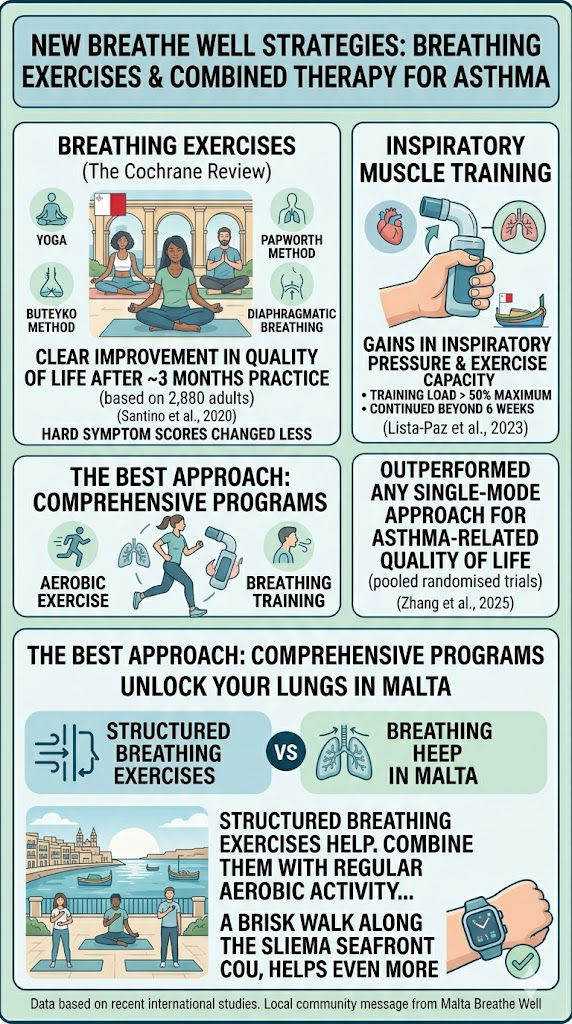
This is where many Malta Breathe Well members will want to lean in. The Cochrane review of breathing exercises in 2,880 adults with mild-to-moderate asthma found a clear improvement in quality of life after roughly three months of practice, including yoga, the Buteyko and Papworth methods and diaphragmatic breathing ; although hard symptom scores changed less (Santino et al., 2020). A 2022 systematic review and meta-analysis specifically on inspiratory muscle training (using a hand-held resistance device) showed gains in inspiratory pressure and exercise capacity when the training load exceeded 50% of maximum and continued beyond six weeks (Lista-Paz et al., 2023). Most encouragingly, a 2025 network meta-analysis pooling randomised trials concluded that comprehensive programmes ; aerobic exercise combined with breathing training ; outperformed any single-mode approach for asthma-related quality of life (Zhang et al., 2025).
Taken together, the message from physiotherapy research is consistent: structured breathing exercises help, and combining them with regular aerobic activity ; a brisk walk along the Sliema seafront counts , helps even more.
Practical take-aways for World Asthma Month
A few simple actions, all backed by the evidence above, can make this month a starting point rather than a one-day campaign. Have your inhaler technique checked by a pharmacist or nurse, and ask your doctor whether you should still be using a short-acting reliever alone or whether a combination reliever is now appropriate. Keep moving ; even 150 minutes of moderate walking per week, combined with daily diaphragmatic breathing, improves quality of life within weeks. Track local pollen and air-quality forecasts on days when the Maltese wind picks up and Parietaria is in flower. Tracking can be done through the local website ; Home | arja.mt ; which gives a locality-based air quality index. And if your asthma is severe or steroid-dependent, ask whether you should be referred for assessment of biologic therapy — the options in 2026 are wider than ever.
Wishing all our members a healthy, well-breathing May.
— Malta Breathe Well Association
References
Bourdin, A., Brusselle, G., Castro, M. et al. (2025) ‘Comparative effectiveness of tezepelumab and dupilumab in severe asthma: a real-world multicentre study’, Journal of Allergy and Clinical Immunology: In Practice. Available at: https://www.jaci-inpractice.org/article/S2213-2198(25)01129-8/pdf (Accessed: 17 May 2026).
D’Amato, G., Cecchi, L., Bonini, S., Nunes, C., Annesi-Maesano, I., Behrendt, H., Liccardi, G., Popov, T. and van Cauwenberge, P. (2007) ‘Allergenic pollen and pollen allergy in Europe’, Allergy, 62(9), pp. 976–990.
Global Initiative for Asthma (GINA) (2025) Global Strategy for Asthma Management and Prevention, 2025 update. Available at: https://ginasthma.org/2025-gina-strategy-report/ (Accessed: 17 May 2026).
Israel, E., Bacharier, L.B., Beasley, R. et al. (2025) ‘As-needed albuterol–budesonide in mild asthma: the BATURA trial’, New England Journal of Medicine.
Liang, Y., Chen, X., Wu, J. et al. (2025) ‘The efficacy and safety of biologics for patients with severe asthma: an umbrella review of systematic reviews and meta-analyses’, Frontiers in Medicine, 12, 1573596.
Lista-Paz, A., Bouza Cousillas, L., Jácome, C., Fregonezi, G., Labata-Lezaun, N., Llurda-Almuçar, L. and Sevenès-Lançon, M. (2023) ‘Effect of respiratory muscle training in asthma: a systematic review and meta-analysis’, Annals of Physical and Rehabilitation Medicine, 66(3), 101691.
Liu, J., Sun, Y., Zhang, H. et al. (2025) ‘The impact of sleep quality on asthma incidence in middle-aged and older adults: evidence from a prospective cohort study’, Frontiers in Public Health, 13, 1646053.
Montefort, S., Ellul, P., Montefort, M., Caruana, S. and Agius Muscat, H. (2009) ‘Increasing prevalence of asthma, allergic rhinitis but not eczema in 5- to 8-year-old Maltese children (ISAAC)’, Pediatric Allergy and Immunology, 20(1), pp. 67–71.
Santino, T.A., Chaves, G.S.S., Freitas, D.A., Fregonezi, G.A.F. and Mendonça, K.M.P.P. (2020) ‘Breathing exercises for adults with asthma’, Cochrane Database of Systematic Reviews, 3, CD001277.
Tian, X., Xue, B., Wang, B. et al. (2024) ‘Association of socioeconomic status and a broad combination of lifestyle factors with adult-onset asthma: a cohort study’, ERJ Open Research, 10.
Wang, Y., Du, M., Liu, J. et al. (2025) ‘Impact of lifestyle factors on adult-onset asthma in genetically high-risk individuals’, Journal of Global Health, 15, 04147.
Zhang, L., Li, X., Chen, Y. et al. (2025) ‘Comprehensive exercise program based on optimal physiotherapy for asthma-related quality of life: a systematic review and network meta-analysis’, Frontiers in Sports and Active Living, 7, 1738390.


Comments